Why your container cost more than the quote
Most first orders from China go wrong in the same place. Not quality, not the factory, not even the shipping line. The unit price.
A buyer compares two quotes, picks the cheaper one, and finds out two months later that the cheaper one cost more to land. The factory did nothing wrong. The freight forwarder did nothing wrong. The buyer simply compared the wrong number.
Here is what is actually going on, and how to stop it happening to you.
Sea freight is sold by space, not by weight
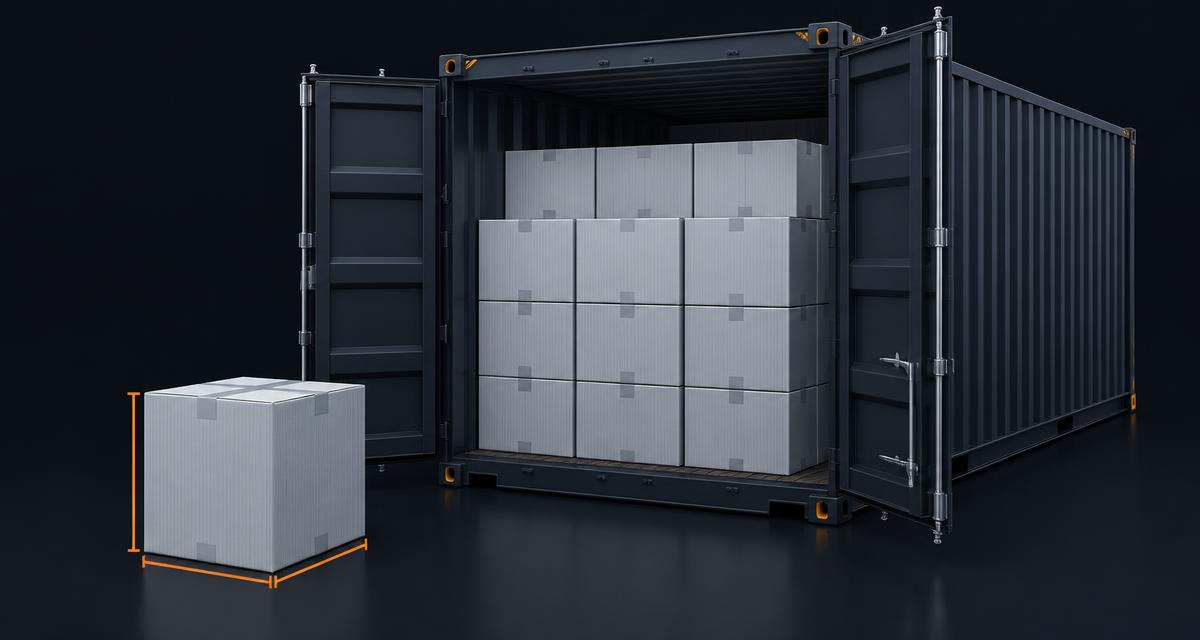
A shipping container is a fixed volume. A 40ft container holds roughly 67 cubic metres of usable space. The line charges you for that space whether you fill it with lead or with pillows.
This is why freight from China is quoted in CBM, cubic metres. One CBM is a box one metre by one metre by one metre.
For dense goods, weight runs out before space does. A container of ceramic tiles hits its weight limit with the container half empty. For almost everything else, and certainly for anything consumer facing, space runs out first. You pay for air.
Air freight works the same way but more aggressively, using a volumetric weight calculation that converts the size of your carton into a chargeable weight. A light, bulky carton gets charged as though it were far heavier than it is.
The number that actually matters
Stop comparing unit price. Start comparing landed cost per unit:
Landed cost per unit  =  unit price
                      +  freight cost per unit
                      +  duty
                      +  any destination charges
Freight cost per unit is the piece buyers skip, and it is the piece that moves.
To work it out you need three things from the factory, and you should ask for them in the same message as the price:
- Carton dimensions in centimetres, outer carton, not the product box
- Units per carton
- Carton gross weight
From those you get cubic metres per carton:
CBM per carton = (length cm × width cm × height cm) ÷ 1,000,000
Divide by units per carton and you have CBM per unit. Multiply by the freight rate per CBM and you have freight cost per unit.
A worked example
Two factories quote you an air cooler. These are illustrative numbers, not a real shipment, but the shape is exactly what you will see.
Factory A Unit price $38. Carton 78 × 42 × 40 cm. Two units per carton.
CBM per carton = (78 × 42 × 40) ÷ 1,000,000 = 0.131 CBM CBM per unit = 0.131 ÷ 2 = 0.0655 CBM
Factory B Unit price $46. Carton 70 × 38 × 36 cm. Two units per carton.
CBM per carton = (70 × 38 × 36) ÷ 1,000,000 = 0.0958 CBM CBM per unit = 0.0958 ÷ 2 = 0.0479 CBM
At a freight rate of $95 per CBM:
| Factory A | Factory B | |
|---|---|---|
| Unit price | $38.00 | $46.00 |
| CBM per unit | 0.0655 | 0.0479 |
| Freight per unit | $6.22 | $4.55 |
| Landed before duty | $44.22 | $50.55 |
Factory A still wins here. But watch what happens when the rate moves to $220 per CBM, which is not an unusual spike:
| Factory A | Factory B | |
|---|---|---|
| Unit price | $38.00 | $46.00 |
| Freight per unit | $14.41 | $10.54 |
| Landed before duty | $52.41 | $56.54 |
The gap narrows from $6.33 to $4.13. Push the packing difference a little further, or the rate a little higher, and the cheaper unit price becomes the more expensive product. On a container of 1,000 units that swing is thousands of dollars, decided entirely by cardboard.
Where buyers lose money without noticing
Comparing ex-works prices across differently packed factories. The most common error. Two quotes are only comparable once both are expressed as landed cost.
Accepting the product box as the shipping carton. Retail boxes are designed to look good on a shelf, not to stack efficiently. Ask whether the factory can pack more units per outer carton, or reduce wasted headspace. A packing change costs the factory almost nothing and can take several percent off your freight.
Ignoring container fill. If your order comes to 58 CBM you are paying for a 40ft high cube and leaving space empty. Either increase the order to fill it or consolidate with something else. Half-empty containers are pure loss.
Forgetting that bulky goods are seasonal. Air coolers and patio heaters are both mostly air in a box. They also sell in opposite halves of the year. Shipping both lets you fill containers across the full twelve months rather than paying for space twice.
What to ask a factory before you talk price
Send this with your first enquiry and you will immediately sound like someone who has done this before:
- Outer carton dimensions in centimetres
- Units per outer carton
- Carton gross and net weight
- Can the carton be optimised for better container fill
- How many units fit a 20ft and a 40ft high cube
- Is the quote ex-works, FOB or CIF, and which port
Any factory that cannot answer the first three quickly is not set up to export properly, and that tells you something before you have risked a penny.
How we quote
Every quotation we issue states the carton size, the units per carton and the cubic metres per unit alongside the unit price. Not because it is impressive, but because without it you cannot compare our quote to anyone else's honestly, and we would rather you could.
We also compare factories on landed cost rather than unit price before we recommend one. The cheapest ex-works quote is frequently not the cheapest product, and a sourcing partner who hands you the lowest unit price without doing that arithmetic has not done the job.
If you are weighing up quotes and want a second pair of eyes on the numbers, send them over.